
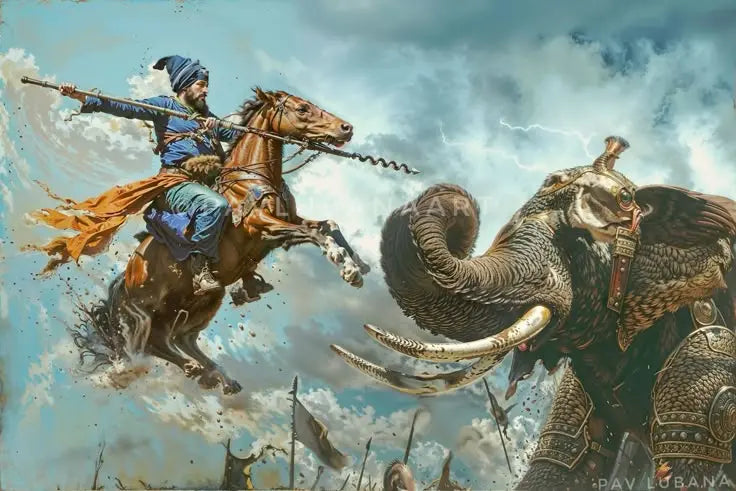
Bhai Bachittar Singh Ji is one of the most celebrated warriors in Sikh history. He is remembered for riding out alone to face an armoured war elephant at Anandpur Sahib, armed with the Nagni Barcha and the blessing of Guru Gobind Singh Ji.
Understanding the life of Bhai Bachittar Singh Ji provides deeper insight into Sikh history, the spirit of the Khalsa and the meaning of courage rooted in faith.
Who Was Bhai Bachittar Singh Ji?
Bhai Bachittar Singh Ji was born in 1664 into a family devoted to the Gurus. He was one of five brothers offered by their father for the service of Guru Gobind Singh Ji.
He received Amrit on Vaisakhi 1699 and became part of the Khalsa from its very beginning. His name is also written as Bachitar Singh or Bichitar Singh.
The Siege of Anandpur Sahib
In 1700, the hill Rajas laid siege to Anandpur Sahib. After failing to break the Sikhs' defence, they turned their attention to Lohgarh fort.
Their plan was to send an intoxicated elephant, its forehead protected by a steel plate, to batter down the gate so their army could pour in.
Chosen by the Guru
Guru Gobind Singh Ji first asked Duni Chand, a masand known for his size and strength, to face the elephant. Duni Chand lost his nerve and fled.
Bhai Bachittar Singh Ji accepted the task without hesitation. Guru Ji gave him the Nagni Barcha and his blessing.
The lesson is remembered to this day. Courage does not come from size or strength. It comes from faith.
The Nagni Barcha
The Nagni Barcha is a spear with a wavy, snake-like blade, taking its name from the word for a serpent.
- Its shape allows it to pierce armour
- It was carried on horseback as well as on foot
- It is counted among the historic Shastars of the Khalsa
The Nagni Barcha carried by Bhai Bachittar Singh Ji is said to be preserved among the Shastars at Takht Sri Kesgarh Sahib.
Facing the Elephant at Lohgarh
As the elephant advanced, the gates of the fort were opened and Bhai Bachittar Singh Ji rode out on horseback.
Rising in his stirrups, he drove the Nagni Barcha through the steel plate and into the elephant's forehead. The wounded animal turned and ran back through the army that had sent it, scattering its ranks.
In the same battle his brother, Bhai Udai Singh Ji, defeated Raja Kesari Chand. The hill Rajas withdrew.
Later Battles and Shaheedi
Bhai Bachittar Singh Ji continued to serve in the battles that followed, including the final battle of Anandpur Sahib.
In December 1705, when Anandpur Sahib was evacuated, he crossed the river Sarsa and was gravely wounded in the fighting near Ropar. He was carried to the home of Nihang Khan at Kotla Nihang Khan, where he attained Shaheedi from his wounds.
What the Life of Bhai Bachittar Singh Ji Teaches
His life continues to guide Sikhs today.
- Courage comes from faith in the Guru, not from physical strength
- Seva means stepping forward when called, whatever the risk
- Shastar are carried with responsibility and for the protection of others
- True bravery is accompanied by humility
Bhai Bachittar Singh Ji and the Shastar Tradition
Shastar hold a respected place in Sikh tradition. They represent the duty to stand against injustice and to protect those who cannot protect themselves.
The Kirpan carries this same principle as an article of faith. The Nagni Barcha of Bhai Bachittar Singh Ji is a reminder that Shastar are honoured for the values they serve.
Many Sikhs keep traditional Shastar and authentic Sikh accessories in the home as a connection to this heritage.
Remembering Bhai Bachittar Singh Ji Today
The Sakhi of Bhai Bachittar Singh Ji is told to Sikh children across the world. It is depicted in historic paintings and remembered at Anandpur Sahib, where the Khalsa was born.
For younger generations, it offers an example of courage and devotion. For the wider community, it reflects the Sikh commitment to standing firm in the face of injustice.
The Enduring Significance of Bhai Bachittar Singh Ji
The significance of Bhai Bachittar Singh Ji lies in his faith. He rode out alone because the Guru asked him to, and he trusted that the Guru's blessing was enough.
His life reminds Sikhs that faith is not passive. It is lived through courage, seva and sacrifice.
Honouring Bhai Bachittar Singh Ji means honouring Sikh history, Sikh values and the spirit of the Khalsa.


