
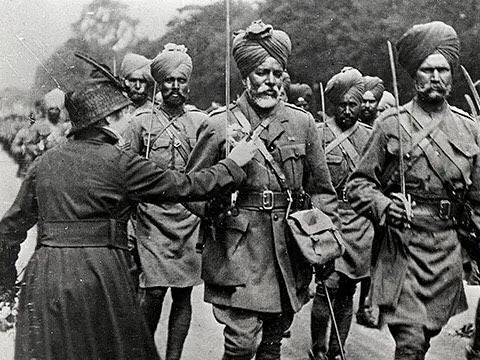
The story of Sikh soldiers in the World Wars is one of courage, discipline and unshakeable faith. Thousands of miles from Punjab, they fought in the trenches of Europe and the jungles of Burma with their Dastars tied and their articles of faith intact.
Understanding the contribution of Sikh soldiers provides deeper insight into Sikh history, Sikh identity and the shared history of Sikhs and Britain.
Who Were the Sikh Soldiers of the World Wars?
Sikh soldiers served in the British Indian Army in both the First and Second World Wars. Although Sikhs were a small minority of India's population, they formed a far larger share of its army.
They were farmers, sons and fathers from the villages of Punjab. Many had never left home before they sailed for Europe.
Where Sikh Soldiers Served
The First World War
Sikh regiments arrived in France in 1914 and fought on the Western Front, including at Neuve Chapelle, Ypres and the Somme. They also served in Gallipoli, Egypt and Mesopotamia.
At Gallipoli in 1915, the 14th Sikhs suffered devastating losses in close fighting and refused to give ground.
The Second World War
Sikh soldiers fought across North Africa, Italy, Burma and Malaya. They served as infantry, cavalry, engineers and pilots.
The Dastar on the Battlefield
When steel helmets were introduced, Sikh soldiers refused to wear them. For a Sikh, the Dastar is not a piece of uniform. It is part of faith and identity.
Officers tried repeatedly to persuade them. The answer did not change, and in time the army accepted that Sikh soldiers would not be made to wear helmets.
They faced shellfire and gunfire with no protection on their heads but the Dastar.
Faith Carried to the Front
Sikh soldiers took their faith with them wherever they were sent.
- Kesh was kept uncut and the Dastar was tied each day
- The Kara and Kirpan were worn in service
- Sri Guru Granth Sahib Ji was carried with the regiments
- Ardas was offered before battle
- Langar was prepared and shared in camp
Faith was not set aside for war. It was the source of their discipline and courage.
The Battle of Saragarhi
The reputation of Sikh soldiers was established well before the World Wars. On 12 September 1897, 21 soldiers of the 36th Sikhs defended the post of Saragarhi against thousands of attackers.
They chose to fight to the last man. Saragarhi is still remembered each September as one of the great last stands in military history.
The Cost of Service
The sacrifice was immense. Across the two World Wars, more than 83,000 Sikh soldiers were killed and more than 109,000 were wounded.
Behind each number was a family in Punjab waiting for news that often took months to arrive.
Remembering Sikh Soldiers in the United Kingdom
Sikh soldiers are honoured across the United Kingdom.
- The Chattri memorial near Brighton
- The Sikh memorial at the National Memorial Arboretum in Staffordshire
- The Lions of the Great War statue in Smethwick
- The Saragarhi monument in Wednesfield
Each November, Sikhs across the country take part in Remembrance Sunday, wearing the poppy alongside the Dastar.
Sikh Soldiers and Sikh Identity
Sikh identity is rooted in discipline, devotion and responsibility. The soldiers of the World Wars carried that identity into the hardest conditions imaginable.
The Dastar, Kara and Kirpan they wore are the same articles of faith worn by Sikhs today. Their example shows that these are commitments to be kept, even at great cost.
Many Sikhs honour this heritage through authentic Sikh accessories that reflect the same faith and discipline.
Why This History Remains Relevant Today
For younger generations, the story of Sikh soldiers provides a powerful connection to both Sikh and British history. It answers the question of belonging with fact.
For the wider community, it is a reminder that the freedoms enjoyed today were defended by people of many faiths and backgrounds.
The Enduring Significance of Sikh Soldiers
The significance of Sikh soldiers in the World Wars lies in what they refused to give up. They gave their service and their lives, but not their faith.
They remind Sikhs that faith is not passive. It is lived through courage, sacrifice and seva.
Honouring them means honouring Sikh history, Sikh values and those who never returned home.


