
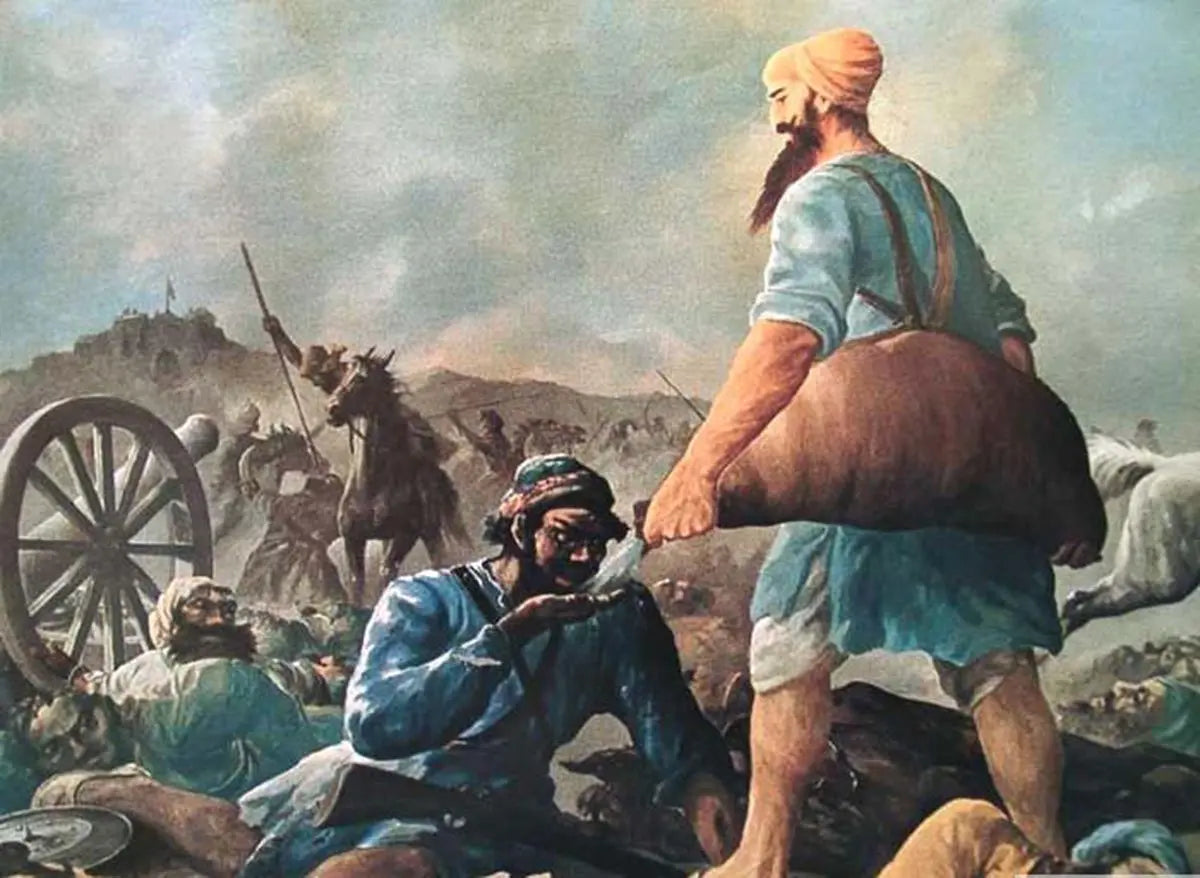
Bhai Kanhaiya Ji is remembered as one of the purest examples of seva in Sikh history. On the battlefield at Anandpur Sahib, he carried water to every wounded soldier he found, Sikh and enemy alike.
Understanding the life of Bhai Kanhaiya Ji gives deeper insight into Sikh history, the meaning of seva and the Sikh belief that the One is present in all.
Who Was Bhai Kanhaiya Ji?
Bhai Kanhaiya Ji was a Sikh of Guru Tegh Bahadur Ji and later served Guru Gobind Singh Ji at Anandpur Sahib.
He is said to have come from a wealthy family but left comfort behind to devote his life to serving the Guru and the Sangat. His seva began with simple tasks such as carrying water, cleaning and caring for others.
Seva on the Battlefield
During the battles at Anandpur Sahib, Bhai Kanhaiya Ji moved among the fallen with a mashak, a leather water bag.
He gave water to every wounded soldier he reached. He did not stop to ask which side they had fought for.
Brought Before the Guru
Some Sikhs were troubled by what they saw. They complained to Guru Gobind Singh Ji that Bhai Kanhaiya Ji was reviving enemy soldiers who might fight again.
Guru Ji called him and asked whether this was true.
Bhai Kanhaiya Ji answered that he did not see friend or enemy. In every face he saw only the Guru.
The Guru’s Blessing
Guru Gobind Singh Ji was pleased with his answer. Guru Ji gave Bhai Kanhaiya Ji a balm and told him to dress the wounds of the injured as well as giving them water.
The lesson is remembered to this day. True seva is offered to all, without condition.
Ik Onkar in Action
The life of Bhai Kanhaiya Ji is the teaching of Ik Onkar lived out in the hardest circumstances.
- If the One is present in all, then no one stands outside our care
- Seva is not limited to those who agree with us
- Compassion and courage can stand side by side
- Humility comes before recognition
The Legacy of Bhai Kanhaiya Ji
Bhai Kanhaiya Ji went on to inspire the Sewapanthi tradition, devoted to selfless service, simple living and care for others.
His example is often recalled alongside the work of modern humanitarian organisations. Long before the Red Cross was founded, a Sikh on the battlefield at Anandpur Sahib was caring for the wounded on both sides.
Bhai Kanhaiya Ji and Seva Today
His spirit continues wherever Sikhs serve others.
- Langar served to anyone who walks through the Gurdwara doors
- Sikh volunteers providing food and water after disasters around the world
- Seva at local shelters, hospitals and food banks across the United Kingdom
- Families serving in the Gurdwara kitchen every week
Many Sikh first aid and humanitarian groups take inspiration directly from his story.
Bhai Kanhaiya Ji and Sikh Identity
Sikh identity is rooted in discipline, devotion and responsibility. The Kirpan stands for the duty to protect. Bhai Kanhaiya Ji shows the other side of that duty, which is to heal.
The Kara on the wrist is a daily reminder that the hands are meant for good deeds. Many Sikhs wear authentic Sikh accessories as a reminder of that commitment.
Why Bhai Kanhaiya Ji Remains Relevant Today
In a divided world, his example speaks clearly. Care for others does not depend on who they are or where they stand.
For younger generations, his story is one of the simplest and most powerful lessons in Sikhi. For the wider community, it reflects the Sikh commitment to serving humanity.
The Enduring Significance of Bhai Kanhaiya Ji
The significance of Bhai Kanhaiya Ji lies in what he saw. Where others saw enemies, he saw the Guru.
He reminds Sikhs that faith is not passive. It is lived through compassion, humility and seva.
Honouring Bhai Kanhaiya Ji means honouring Sikh history, Sikh values and the oneness of all creation.


